
Clear Attention
Students are taught what to learn, but never how to pay attention.
Clear Attention is elite instruction and attention training
100% of 8th graders passed the NYS ELA and Math Exams
100% of 8th graders passed the NYS History Regents Exams
100% of 12th graders passed AP Literature in 2021-2022
93% of 12th graders (200+) passed AP Literature from 2021-2025
54% of students reported a measurable decrease in mind-wandering and a higher capacity to stay focused during complex tasks.
40% of students developed a stronger awareness of their own thinking patterns, specifically during high-stakes assessments.
100% of students identified Clear Attention methodologies as a vital tool for managing academic stress and deadlines.
Curriculum and Practicum
Elite Instruction
In class or on high-stakes exams like the SAT, ACT, and AP’s performance is determined by
Content Fluency: We use elite-level curricula to ensure students are processing the most relevant information for their specific goals.
Retrieval: We train the memory to develop skills, ensuring that under the pressure of a time constraint, knowledge is reliably accessible.
Permanent Alteration: Following the research, we define success as a relatively permanent change in the student’s long-term memory.
-
Success in core subjects is determined by knowledge and fluency. In these courses, we:
Identify Main Idea, Craft and Structure, and Author’s Purpose in complex texts; decoding, fluency, and elementary reading comprehension for younger learners
Develop the process, vocabulary, logic, speed, and sophistication of argumentative writing; capitalization, punctuation, parts of speech, and components of sentences for younger learners
Develop and solidify mathematical concepts through explicit instruction and guided practice with a focus on reading and organizational habits that improve precision
These courses can be taken together or in isolation; each can be modified depending on a client’s schedule and/or needs.
-
Standardized tests require a demonstration of knowledge in a specific context and therefore testing requires its own explicit instruction. In this course, we:
Identify content gaps and ensure content mastery required to reach a client’s goals
Learn and develop a fluency of strategies for specific testing components and question types
Develop strategies for managing time and cognitive load
This course is comprehensive but can be modified depending on a client’s schedule and/or needs.
-
One of the most underdeveloped skills is also one of the biggest pain points for college professors and high school teachers. Today’s students simply don’t know how to study or take notes in class. In this course, we:
Understand how learning occurs in the brain and how to leverage this understanding with specific studying strategies
Understand when to actively listen in a lesson or lecture vs. when to construct meaning in notes
Settle the debate between Hand-written vs. Type Notes
Understand how to create study materials from lecture notes
Develop and schedule interleaved, spaced practice to solidify long-term memory encoding and to avoid “cramming”
This course is comprehensive; scheduling can be modified depending on a client’s availability.
-
A college application is narrative, not just a list of grades and accomplishments. In this course, we:
Develop an application persona to meet the academic criteria and the student profile of each school
Develop an Independent Project that captures the client’s application persona and makes their application salient to college admissions officers
Develop an Activities List that highlights a client’s contribution to their school community and environment
Identify client’s goals and prioritize “fit” – a strategic range of schools
Draft and craft a personal statement and supplemental essays that align with a client’s application persona and demonstrates elite writing capability
Create and sustain a workflow calendar to ensure that a client is on track through each phase leading up to application deadlines
This course is designed for clients who are between entering freshman year and before the 2nd semester of their junior year at the latest. The earlier a client begins, the better the results are likely to be. This course is recommended to be taken along with Standardized Testing.
-
At best, most students manage time with a daily to-do list. Elite performers manage time with a range of tools and know which to use and when. In this course, we:
Set long, medium, and short-term goals and use Backwards Planning Design to meet them
Identify digital tools, how and when to use them
Analyze weekly bandwidth, create systems and routines to strategically organize tasks
Learn how and why to block out Deep Work sessions for longer, complex work
Learn what “rest” actually is, why it’s important, and when to schedule time for it
This course is comprehensive; scheduling can be modified depending on a client’s availability.
-
If success is the foreground, the environment is the background. In this course, we:
Audit a client’s digital space to eliminate app and notification fatigue
Identify highest leverage digital tools for task-oriented goals and specific contexts in which to use them
Learn to adopt habits that improve focus and the quality of worktime
Analyze a client’s physical workspace to engineer faster, sustained attention
This course is comprehensive; scheduling can be modified depending on a client’s availability.
Attention Training
-
The quality of your attention determines the quality of your learning, and attention can be explicitly trained. In this course we:
Understand what attention and distraction are conceptually and experientially
Develop the ability to notice when the mind is distracted, improving the speed of recovering focus
Develop the ability to reorient attention to a goal-oriented task, improving the quality of one’s focused attention
Improve attentional fluency through Focused Attention training, and establish a foundation for Attention to … and Sustained Focus courses
Improve meta-awareness through Open Monitoring training to establish a foundation for Attention to … and Sustained Focus courses
This course is a prerequisite to each Attention Training course. This course is comprehensive and can be modified depending on a client’s schedule and/or additional needs.
-
The act of reading occurs visually, and the comprehension of language occurs cognitively. Building on the Fundamentals of Attention and Distraction, learn how to pay to the process of reading itself. In this course we:
Develop attention to on-task reading comprehension
Improve ability to read for longer periods and to extract more complex ideas
Adopt metacognitive habits to not just understand but to enjoy the process of understanding texts
Develop metacognitive awareness through conversation to build foundations for complex and sophisticated writing
Attention & Distraction 101 is a prerequisite to this course. This course is comprehensive, should be tailored to a client’s reading level, and can be modified depending on a client’s schedule and/or additional needs.
-
Writing requires transcription of thought onto the page for a specific audience, and therefore requires clarity of one’s own thinking and a clear, accurate estimation of what one expects the reader to understand. In this course, we:
Understand the basics of logical deduction and induction to establish the foundations for argumentative writing
Develop habits for planning high-level writing through Open-Monitoring training
Practice processing the transmutation of thinking, planning, and writing to predictably write clear, argumentative short responses and longer form essays
Develop the metacognitive habits for ensuring clarity, complexity, and sophistication in the final writing through Open-Monitoring
Attention & Distraction 101 is a prerequisite to this course. This course is comprehensive, should be tailored to a client’s reading and writing level, and can be modified depending on a client’s schedule and/or additional needs.
-
“I understand it when I do the homework, but when I get to the test …” is a common phrase among students who feel they are underperforming in their math class. Math mistakes are attention errors if not misunderstandings of the material. In this course we:
Distinguish gaps in mathematical understandings vs. in accuracy, understanding, and inconsistencies in approaches to multistep problems
Develop habits for ensuring precision and planning clear, logical work for high-level questions
Develop metacognitive lenses to increase calculation speed and rote processing through Focused Attention training
Develop metacognitive lenses through Open-Monitoring to notice deviations in logic to eliminate simple mistakes that cap scores
Attention & Distraction 101 is a prerequisite to this course. This course is comprehensive, should be tailored to a client’s math level, and can be modified depending on a client’s schedule and/or additional needs.
-
Due to technology, it is becoming increasingly difficult to sustain attention over long periods of time. In order to be successful students must develop attentional stamina. In this course we:
Develop Focused Attention (FA) over progressively longer periods of time
Develop Open Monitoring (OM) alongside Focused Attention to preserve attention by noticing distraction and reorienting distraction
Apply the principles of FA and OM training in high-stakes performative contexts, e.g. Standardized Tests
Attention & Distraction 101 is a prerequisite to this course. This course is comprehensive and recommended to be taken alongside the Standardized Testing Course. This course can be modified depending on a client’s schedule and/or additional needs.
-
Some students are able to pay attention just fine so long as there aren’t any distractions. This course benefits students who struggle with distraction in particular, especially those who respond to distraction with stress and anxiety. In this course we:
Further develop Open Monitoring (OM) to distinguish “noise” from “signal”
Develop the ability to dereify distraction-related stress as itself a distraction
Develop the non-judgemental meta-awareness to redirect attention efficiently
Attention & Distraction 101 is a prerequisite to this course. This course is comprehensive and recommended to be taken alongside the Standardized Testing Course if a client believes they have stress or anxiety around testing in particular. This course can be modified depending on a client’s schedule and/or additional needs.
Improving cognitive resource management by training Focused Attention and Open Monitoring
Attention Literacy: We teach students to consciously direct their focus, notice distraction, and reorient attention.
Sustained Learning: We build the attentional endurance required to preserve Working Memory for complex, goal-oriented tasks.
Relationship to Learning: We help students recognize that they are not separate from their learning environment—they are the learning environment. By mastering their attention, they master their learning.
“Pay attention!
You just might learn something.”
That snarky teacher was right. You might learn if you pay attention, but did anyone ever teach you how?
Since Attention is the necessary condition prior to learning, it is the biggest blind spot in education.
At Clear Attention, we help clients meet their goals by explicitly teaching them how to pay attention in the context of traditional academic coaching.
Learn about the mechanics of attention, the subtleties of distraction, and then try a short practice below.
"An education which should succeed in training attention would be the education par excellence."
- William James
American psychologist and philosopher
How Learning Works
Attention selects, delivers, and sustains information in Working Memory, so that it is encoded in Long-Term Memory. When information is successfully retrieved and remembered, learning has occurred. Simply put, learning is remembering.
If we choose to include the mind of the learner as a part of the learning environment—and their attention is developed explicitly—they develop competence in managing their own cognition. With competence comes agency, and with agency comes motivation.
Competent, motivated students actively maximize their learning in concert with their environment, rather than simply depending on it.
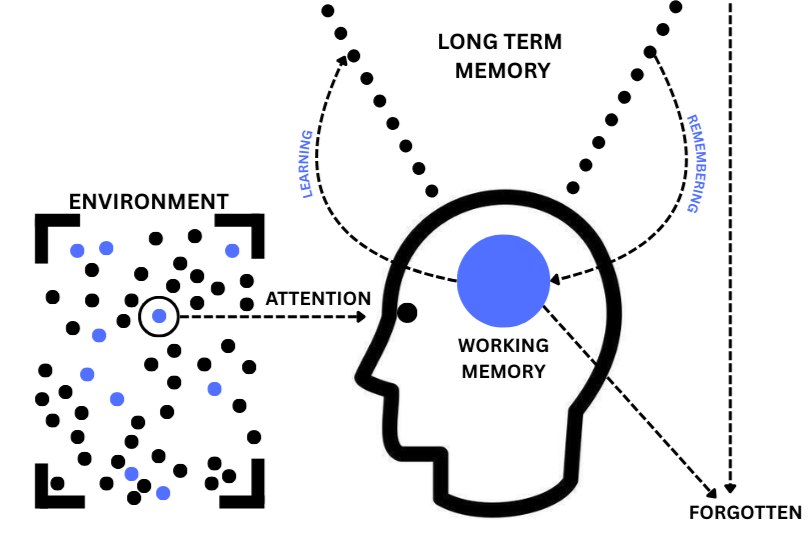
Adapted from Daniel T. Willingham’s A Mental Model of the Learner: Teaching the Basic Science of Educational Psychology to Future Teachers (2017)
Willingham’s Simple Memory Model, illustrated by Oliver Caviglioli
Why Attention is the Key
The mind is the learning environment. It’s the only part of the environment where learning happens. An ethical education is one that explicitly teaches students how to pay attention to their mind by training their ability to notice distraction and reorient focus. Stable attention inhibits distraction, preserves Working Memory, and optimizes learning.
At Clear Attention, we improve students’ ability to manage cognitive load in and outside of the classroom, by treating attention as trainable and the primary condition for learning.

Adapted from Daniel T. Willingham’s A Mental Model of the Learner: Teaching the Basic Science of Educational Psychology to Future Teachers (2017)
Willingham’s Simple Memory Model, illustrated by Oliver Caviglioli
Contact Us
Ready to improve your attention and reach your potential?
Share your information, concerns, and book a free Performance Assessment.